Showing posts with label Entomogenous Fungi. Show all posts

Friday, 7 December 2012

Some Cordyceps and Paecilomyces spp that have produced fruiting bodies in artificial conditions


1. Cordyceps militaris, 2. Cordyceps taii, 3. Cordyceps phecocephla, 4. Cordyceps longissima,  5. Cordyceps bassiana, 6. Cordyceps oxycephala, 7. Cordyceps gracilioides, 8. Cordyceps myrmecophila, 9. Cordyceps formicarum, 10. Cordyceps formosana Kobayasi & Shimizu, 11. Cordyceps brongniatii, 12. Cordyceps nutans,  13. Cordyceps bifusispora aff., 14. Cordyceps gunnii var. minor

( 十七种虫草的子实体培育研究 Artificial culture of seventeen Cordyceps spp.
LI Chun-Ru, NAM Sung-Hee, GENG De-Gui, FAN Mei-Zhen, LI Zeng-Zhi )


Cordyceps sp. of Dr. Tapingkae (ทะพิงค์แก)
And (O)C. sobolifera cultivated with the same method.
( www.tapingkae.in.th )


Cordyceps/Ophiocordyceps sinensis
( Professors Shen Nan Ying 沈南英 and Ke Chuan-Kui 柯传奎 1980's - 2004? )


Semicultivated Cordyceps/Ophiocordyceps sinensis
( Chinavivers and Daniel Winkler )


Paecilomyces cicadae ( Chai Yiqiu 柴一秋 ), Cordyceps cicadae (WANG, Yongjun et al .)


Paecilomyces/Isaria  japonica/tenuipes, Cordyceps pruinosa (Ho Gyoung Kim et al .)


and fumosoroseus, takaomontana, sinclairii, ophioglossoides, etc.etc...
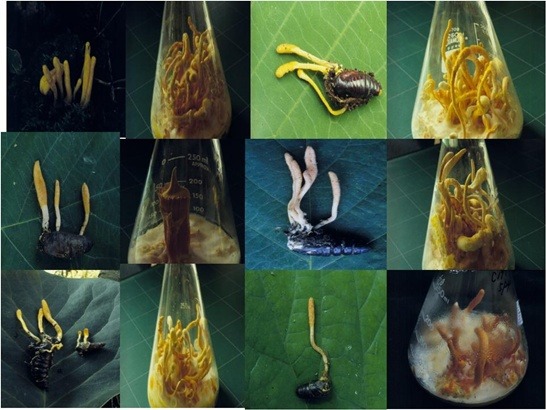


few more nice pictures ( from www.mushtech.co.kr )


Friday, 30 November 2012

Methods for isolation of entomopathogenic fungi from the soil environment

by Nicolai V. Meyling

Summary
Descriptions of methods and recommendation of laboratory procedures for the isolation of
soil borne entomopathogenic fungi (specifically Beauveria spp. and M. anisopliae) are
presented. For screening of occurrences of indigenous populations of entomopathogenic fungi
the insect bait method is recommended. Further recommendations are: 1) Collect sufficient
number of soil samples to cover the area of investigation; 2) if the bait method is used, apply
sufficient individuals of bait insects to each sample to increase the likelihood of isolating the
fungi present. Descriptions of isolation methods, statistical analyses of the data and
preparation of media and bait insects are given.

http://docs.google.com/viewer?url=http://orgprints.org/11200/1/11200.pdf

Thursday, 29 November 2012

Selective Media for Isolation of Entomogenous Fungi

(from: Bioassays of Entomopathogenic Microbes and Nematodes CABI)

Veen’s agar medium (1 l) (Veen and Ferron, 1966)

35 g Mycological agar (Difco) or 10 g Oxoid neutralized soya peptone, 10 g
dextrose, 15 g No. 1. agar (or Bacto-agar), 1 g chloramphenicol (store 4°C),
and 0.5 g cycloheximide (= Actidione; store 4°C). Add 1 l distilled water, stir,
and cover. Autoclave for 10–15 min at 18–20 psi. Cool to c. 52°C and pour
plates in laminar flow cabinet.


Oatmeal dodine agar (Beilharz et al., 1982)

1. Antibiotic stock solution: add 4 g penicillin G (Sigma) and 10g streptomycin
sulphate (Sigma) to 40 ml sterile distilled water under sterile conditions.
Store at 4°C.
2. Crystal violet stock solution: add 0.1 g crystal violet (Sigma) to 200 ml distilled
water. Store in the dark.
3. Add 17.5 g oatmeal agar (Difco) and 2.5 g agar (Fisons) slowly to 0.5 l
distilled water while stirring vigorously and heat to boil.
4. Add 0.5 ml of the fungicide dodine (N-dodecylguanidine monoacetate;
Cyprex 65WP, American Cyanamid Co.) and 5 ml crystal violet stock solution
to the medium.
5. Autoclave for 20 min at 15 psi.
6. Allow medium to cool to 50–55°C and add 2 ml of antibiotic stock solution
under sterile conditions.
7. Swirl flask well to ensure thorough mixing of compounds and pour while
warm. There should be enough media for twenty 9-cm diameter Petri
dishes.


Selective agar medium (1 l) (Kerry et al., 1993)

37.5 mg carbendazim, 37.5 mg thiabendazole, 75 mg rose bengal, 17.5 g
NaCl, 50 mg each of streptomycin sulphate, aureomycin and chloramphenicol,
3 ml Triton X-100, and 17 g corn meal agar (Oxoid) in 1 l distilled water.
This medium is appropriate for selecting some Paecilomyces spp. and
Verticillium spp. from soil.


Paecilomyces lilicanus medium (Mitchell et al., 1987)

To prepare 1 l of medium, mix the following: 39 g PDA, 10–30 g NaCl, 1 g
Tergitol, 500 mg pentachloronitrobenzene, 500 mg benomyl, 100 mg streptomycin
sulphate, and 50 mg chlorotetracycline hydrochloride.


Wheat germ based selective agar medium (1 l) (Sneh, 1991)

1. Prepare an aqueous extract of wheat germ – mix 30 g wheat germ in 1 l
water, autoclave for 10 min and filter through four layers of cheesecloth.
2. Mix wheat germ extract (1 l) with 0.25 g chloramphenicol (heat stable) +
0.8 mg benlate (50% benomyl), 0.3 g dodine (65% n-dodecyl-guanidine
acetate), 10 mg crystal violet and 15 g agar.
3. Autoclave and pour into plates.


Copper-based selective agar medium (1 l) (Baath, 1991)

2% malt extract (Oxoid), 1.5% Agar (Difco) amended with 2–4 mg
CuSO4·5H2O per litre. Cordyceps militaris and Paecilomyces farinosus are
tolerant of high Cu levels (400 mg/L, followed by Metarhizium anisopliae
and Beauveria bassiana. Most other soil-borne fungi including
nematophagous species of Verticillium were less tolerant.